Explore scenes where HMM helps
Explore scenes where HMM helps
The HMM Manifesto: Reclaiming Your Academic Capital
For PIs battling the gap between engineering hassles and scientific discovery
The HMM Manifesto: Reclaiming Your Academic Capital
For PIs battling the gap between engineering hassles and scientific discovery
In today's cutthroat academic landscape, your most precious resources are TIME and your team’s INTELLECTUAL ENERGY, not your budget.
However, when your cutting-edge research demands a customized or advanced Laser Scanning Microscopy (LSM) system, the reality often descends into an ENGINEERING TRAP:
- The "Jitter Juggle": Your brilliant Ph.D. student spends six months tuning ns-level synchronization (Jitter) between disjointed cards from multiple vendors.
- The "Hero Dependence": Your lab becomes heavily dependent on a single "electronics guru." When they graduate, the system becomes a technical silo that no one can maintain or upgrade.
- The "Data Integrity Question": You are forced to patch together scan control and data acquisition, creating a spaghetti-wire setup that increases maintenance costs and introduces hidden risks to data honesty.
The HMM "Hassle-free" Commitment: Reclaim Control and Accelerate Your Research
The TLI-HMM (Hassle-free Microscopy Manager) was born to liberate your lab from the quicksand of low-level electronics. We have "digitized" and "platformized" complex optical control logic, offering you:
- Deterministic "Single-Card Sync" Core We deeply understand the difficulty of ns-level synchronization between lasers, galvanometers (Galvo/Resonant), and detectors. HMM achieves this through deep FPGA-level hardware intervention, integrating chaotic timing—previously requiring multiple card collaborations—into a single digital thread. Your data’s precision is guaranteed from Day One.
- Skip the 6-Month⁺ Dev Cycle; Enter Direct Data Output HMM is not a raw acquisition card requiring low-level programming; it is a pre-integrated control platform. Through an intuitive UI and high-level API, your students skip months of driver debugging, shrinking "system setup time" from half a year⁺ to mere weeks or less, significantly ahead of your competitors.
- Strategic Continuity over "Hero" Dependency With HMM's standardized control architecture, you no longer worry about talent discontinuity. HMM's operational logic is sustainable and maintainable. Your core equipment will run stably ensuring research continuity and technical asset preservation.
"We are not just optimizing microscopes; we are optimizing your scientific productivity."
TLI HMM gives your team true freedom—liberated from engineering hassles—to pursue the next groundbreaking scientific discovery.
In today's cutthroat academic landscape, your most precious resources are TIME and your team’s INTELLECTUAL ENERGY, not your budget.
However, when your cutting-edge research demands a customized or advanced Laser Scanning Microscopy (LSM) system, the reality often descends into an ENGINEERING TRAP:
- The "Jitter Juggle": Your brilliant Ph.D. student spends six months tuning ns-level synchronization (Jitter) between disjointed cards from multiple vendors.
- The "Hero Dependence": Your lab becomes heavily dependent on a single "electronics guru." When they graduate, the system becomes a technical silo that no one can maintain or upgrade.
- The "Data Integrity Question": You are forced to patch together scan control and data acquisition, creating a spaghetti-wire setup that increases maintenance costs and introduces hidden risks to data honesty.
The HMM "Hassle-free" Commitment: Reclaim Control and Accelerate Your Research
The TLI-HMM (Hassle-free Microscopy Manager) was born to liberate your lab from the quicksand of low-level electronics. We have "digitized" and "platformized" complex optical control logic, offering you:
- Deterministic "Single-Card Sync" Core We deeply understand the difficulty of ns-level synchronization between lasers, galvanometers (Galvo/Resonant), and detectors. HMM achieves this through deep FPGA-level hardware intervention, integrating chaotic timing—previously requiring multiple card collaborations—into a single digital thread. Your data’s precision is guaranteed from Day One.
- Skip the 6-Month⁺ Dev Cycle; Enter Direct Data Output HMM is not a raw acquisition card requiring low-level programming; it is a pre-integrated control platform. Through an intuitive UI and high-level API, your students skip months of driver debugging, shrinking "system setup time" from half a year⁺ to mere weeks or less, significantly ahead of your competitors.
- Strategic Continuity over "Hero" Dependency With HMM's standardized control architecture, you no longer worry about talent discontinuity. HMM's operational logic is sustainable and maintainable. Your core equipment will run stably ensuring research continuity and technical asset preservation.
"We are not just optimizing microscopes; we are optimizing your scientific productivity."
TLI HMM gives your team true freedom—liberated from engineering hassles—to pursue the next groundbreaking scientific discovery.
For all Open-Architecture Advanced Microscopy Developers
For all Open-Architecture Advanced Microscopy Developers

What Once Took Many Cards and Experts, Now HMM Does All
What Once Took Many Cards and Experts, Now HMM Does All

TLI-HMM Integrates 4Chs 1GS/s High-speed Data Acquisition, In-Line processing,
Sync Signal, and Control Software in One Platform
TLI-HMM Integrates 4Chs 1GS/s High-speed Data Acquisition, In-Line processing, Sync Signal, and Control Software in One Platform

HMM for Laser Scanning Microscopies
HMM for Laser Scanning Microscopies
Remarkable System Simplification with TLI HMM-SC Design for Research and Prototyping
Remarkable System Simplification with TLI HMM-SC Design for Research and Prototyping

Build Video Cube Rate Multiphoton/Confocal Microscope with TLI-HMM-SC
Build Video Cube Rate Multiphoton/Confocal Microscope with TLI-HMM-SC

Build Circular Dichroism Microscope with TLI-HMM-SC
Build Circular Dichroism Microscope with TLI-HMM-SC

Build FLIM Microscope with TLI-HMM-SC
Build FLIM Microscope with
TLI-HMM-SC

Build FLIM Multimodality Microscope with TLI-HMM-SC
Build FLIM Multimodality Microscope with TLI-HMM-SC

Build FLIM Multimodality Microscope with TLI-HMM-SC
Build FLIM Multimodality Microscope with TLI-HMM-SC

Build Light Sheet Microscope with TLI-HMM
Build Light Sheet Microscope with TLI-HMM

Multiphoton-Microscope with TLI-HMM-SC
High Sampling Rate Brings Better Image Quality
Multiphoton-Microscope with TLI-HMM-SC
High Sampling Rate Brings Better Image Quality

Video Rate Multiphoton-Microscope with TLI-HMM-SC
High-Speed, High Resolution, no Compromise
Video Rate Multiphoton-Microscope with TLI-HMM-SC
High-Speed, High Resolution,
no Compromise

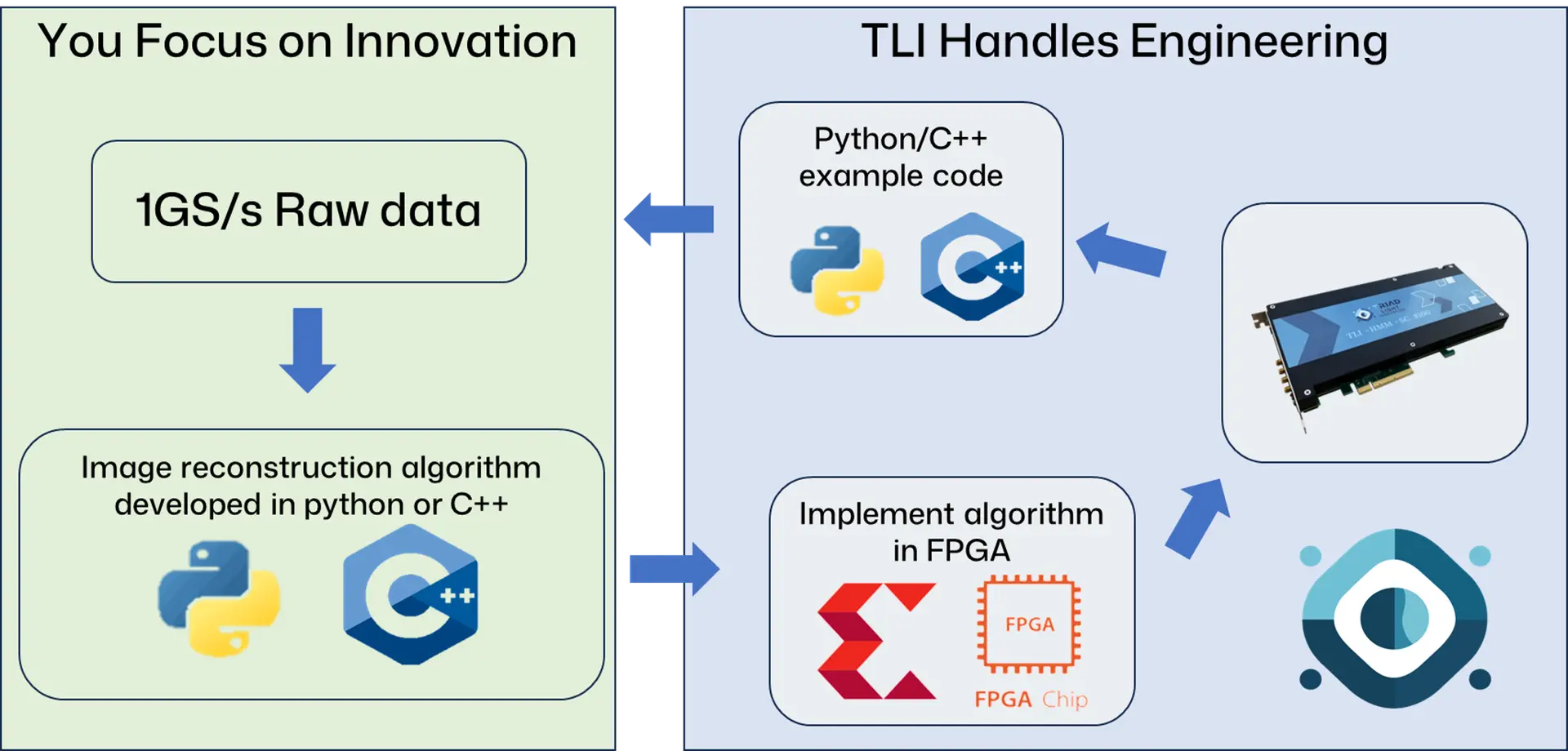
Customized Algorithm Workflow with TLI-HMM-SC
Customized Algorithm Workflow with TLI-HMM-SC
Integrate TLI-HMM with GPU
Integrate TLI-HMM with GPU

Customized Algorithm Example : Precise Peak Detection
Customized Algorithm Example : Precise Peak Detection

Customized Algorithm Example : Time Resolved SHG/THG and Fluorescence Image
Customized Algorithm Example : Time Resolved SHG/THG and Fluorescence Image

Unique Advantages of the TLI-HMM-SC
Unique Advantages of the
TLI-HMM-SC
- Plug-and-Play Integration – A single PCIe card consolidates high-speed signal acquisition, scanner control, and real-time image reconstruction, eliminating the need for multiple hardware modules and reducing integration time from months to minutes.
- Ultra-compact, Engineering-oriented Form Factor – The card-level design drastically reduces system footprint, making it especially suitable as a prototyping platform for next-generation microscopy development, where flexibility and rapid iteration are critical.
- Low Host Computer Requirements – With FPGA-based in-line processing, most heavy computation is handled on-board, allowing operation with standard PCs instead of costly high-performance workstations.
- True Real-time Performance – High-throughput (1 GS/s, 16-bit) acquisition combined with low-latency FPGA pipelines enables immediate feedback, critical for live imaging, fast scanning, and time-sensitive experiments.
- Multi-technology Compatibility – The architecture is inherently modular, supporting confocal, multiphoton, STED, TIRF, SNOM, FLIM, Chiral Dichroism, and photoacoustic microscopy on the same unified platform.
- Scalability and Future-proof Design – A reconfigurable FPGA core and microSD-based firmware updates allow continuous upgrades, ensuring long-term adaptability without hardware replacement.
- Researcher-centric Workflow – By removing the burden of cross-device integration and synchronization, scientists can focus on optical innovation and biological discovery, not engineering bottlenecks.
- Plug-and-Play Integration – A single PCIe card consolidates high-speed signal acquisition, scanner control, and real-time image reconstruction, eliminating the need for multiple hardware modules and reducing integration time from months to minutes.
- Ultra-compact, Engineering-oriented Form Factor – The card-level design drastically reduces system footprint, making it especially suitable as a prototyping platform for next-generation microscopy development, where flexibility and rapid iteration are critical.
- Low Host Computer Requirements – With FPGA-based in-line processing, most heavy computation is handled on-board, allowing operation with standard PCs instead of costly high-performance workstations.
- True Real-time Performance – High-throughput (1 GS/s, 16-bit) acquisition combined with low-latency FPGA pipelines enables immediate feedback, critical for live imaging, fast scanning, and time-sensitive experiments.
- Multi-technology Compatibility – The architecture is inherently modular, supporting confocal, multiphoton, STED, TIRF, SNOM, FLIM, Chiral Dichroism, and photoacoustic microscopy on the same unified platform.
- Scalability and Future-proof Design – A reconfigurable FPGA core and microSD-based firmware updates allow continuous upgrades, ensuring long-term adaptability without hardware replacement.
- Researcher-centric Workflow – By removing the burden of cross-device integration and synchronization, scientists can focus on optical innovation and biological discovery, not engineering bottlenecks.